The answer, the files it consulted, and one click to open them.
Answers list their sources — one click opens the real file. Answers are generated from the matching excerpts of the documents you indexed, so a citation is not decoration: it is the document QcHelper actually read to write that sentence.
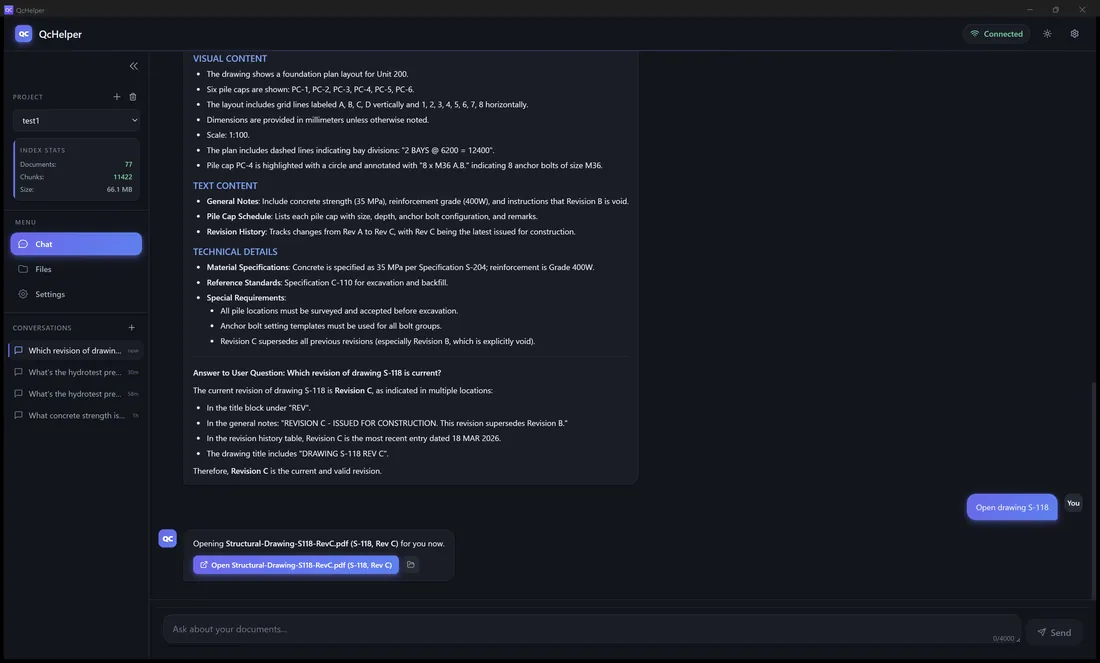
Real app screenshot — the documents shown are a demonstration project.
100 questions, typed into the real app by a machine.
In June 2026, VincData ran QcHelper through a 100-question machine-scored battery: two runs of 50 questions, each set freshly generated from a live project index of over 2,000 documents (not the demonstration project shown in screenshots), typed into the real application by an automated harness and scored by a grading script. The questions covered the work a QC day actually asks.
| Question category | Questions | What the run tested |
|---|---|---|
| Specification lookups | 16 | Real content, with cited filenames; every cited filename machine-checked, answers spot-read by a person. |
| Document searches | 16 | The right documents are found and named. |
| Multi-step follow-up threads | 14 | Context holds across a seven-step conversation about the same documents. |
| Counts | 10 | “How many” answers are checked against the index’s own count. |
| Robustness phrasings | 10 | Rephrased, mistyped and rambling questions still route to the right documents. |
| Honesty traps | 10 | Questions with no answer in the set are declined, with nothing invented. |
| Value extraction | 8 | Specific values — pressures, strengths, dates — are taken from the documents. |
| Exact-file questions and summaries | 8 | A question about one named file is answered from that file. |
| Revision checks | 4 | The revision stated matches the highest revision in the index. |
| Revision comparison | 4 | Differences between revisions come from the documents. |
Every cited filename was checked against the index.
QcHelper cites by document filename. After each run, a grading script pulled every filename cited in every answer and looked it up in the index’s document table — first as an exact match, then as a suffix match, then with any leading prose trimmed away. A cited filename with no match in the index counts as a fabrication and fails the question.
Ten trap questions. Ten answers that invented nothing.
Ask about something your documents don’t cover, and QcHelper says exactly that — and shows what it reviewed. To test it, each 50-question run included five honesty traps — four generated so that the answer provably did not exist in the index, plus one real project term misspelled:
“The document QX-49-2804 was not found in the provided sources. Although several other documents were retrieved during the search, none of them correspond to the identifier QX-49-2804. Therefore, its revision cannot be determined from the available information.”
A refusal from run 2 of the June 2026 battery. The drawing number is synthetic.
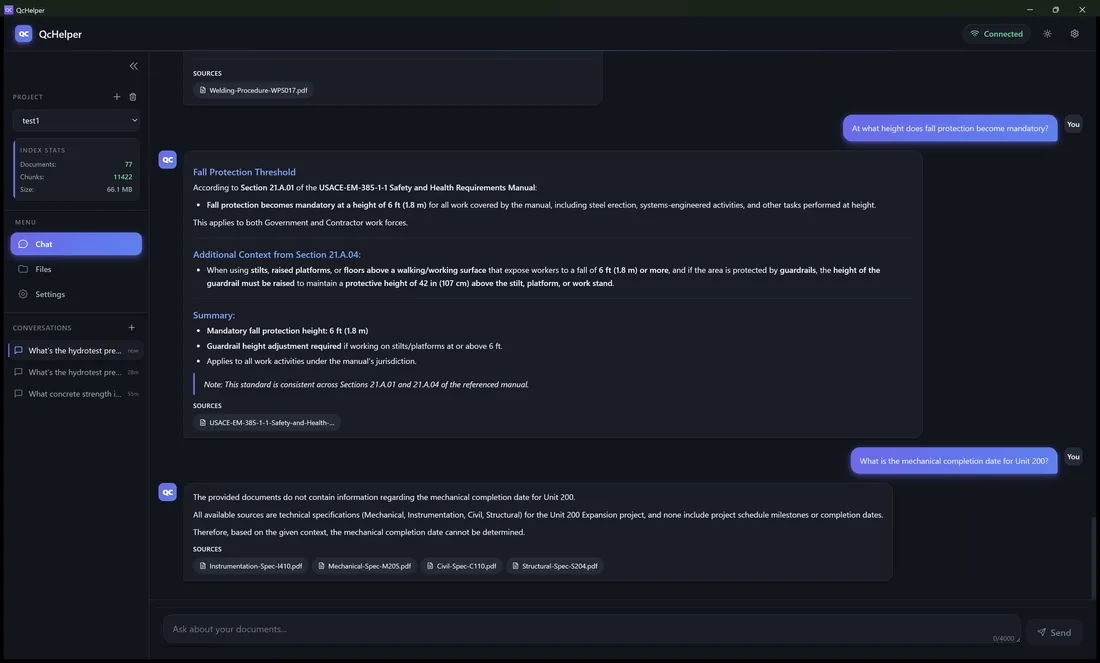
Real app screenshot — a not-in-the-documents question on the demonstration project, not one of the 10 battery traps.
The revision is on the source. You make the call.
A citation to the wrong revision is as dangerous as a wrong number. Revisions are read from file names, or from a revision marker near the start of a document’s text, and documents filed in superseded, obsolete, archive or old folders get lower weight in search. When your documents record a supersession — a title block, a revision table — the answer can report it and cite where. QcHelper does not parse title blocks or verify revision status on its own: check the cited source.
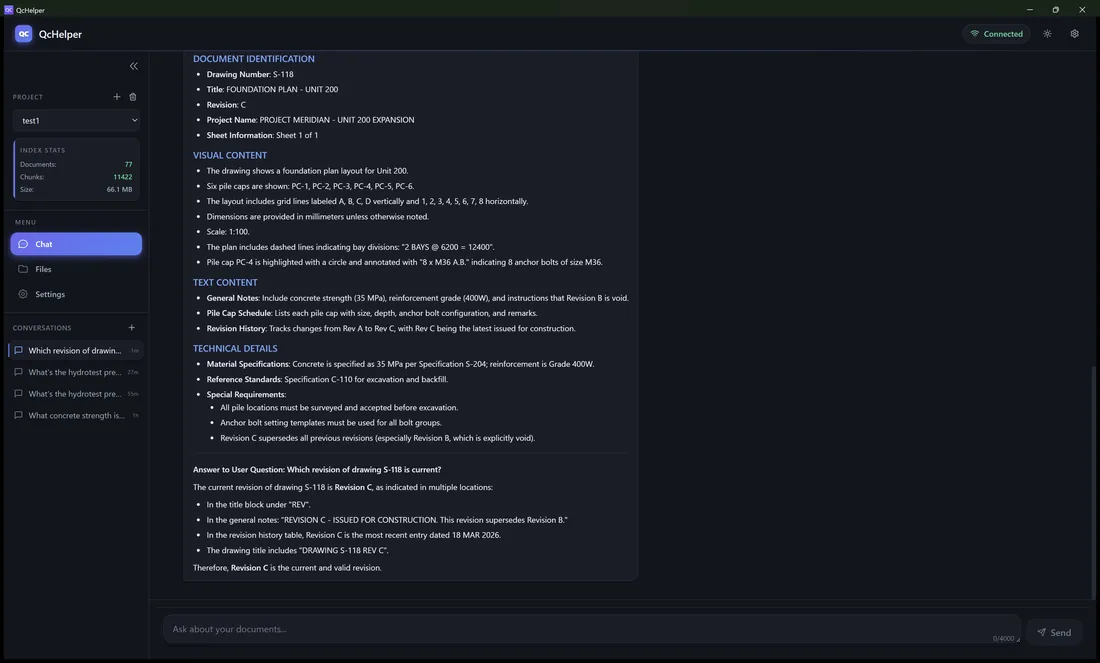
Real app screenshot — demonstration project. Revision checks were 4 of the 100 battery questions, scored against the highest revision in the index.
What these numbers do and don’t say.
No. 100 questions were asked across two runs of 50. The answers cited 790 document filenames in total, and all 790 matched a document in the index. It is 790 citations, not 790 questions or 790 answers.
A cited filename that matches no document in the index — an invented source. A typo in the name of a real document is logged as a citation defect, not a fabrication, which is why the figure says “0 confirmed fabrications” rather than “0 errors”.
A question designed to tempt a made-up answer: a drawing number that does not exist, a made-up word, a file that is not there, an off-topic question, or a real term misspelled. A pass means QcHelper invented nothing — it said the information was not found. 10/10 passed in June 2026.
No. It was internal automated verification by VincData in June 2026: two 50-question runs over a single night on one project index, with a fix applied between the runs. Pilot participants watch QcHelper answer on their own documents, which is the test that matters for you.
No. Screenshots are live captures of the real QcHelper application answering a demonstration project. The verification battery ran on a separate live project index of over 2,000 documents.
Yes. It is an AI assistant working from document excerpts, and it can misread or mis-transcribe. That is why answers list their sources, and a source opens in one click. Verify AI answers against cited sources before acting on them.
Architecture, data flow and the security checklist: Security & IT overview →